
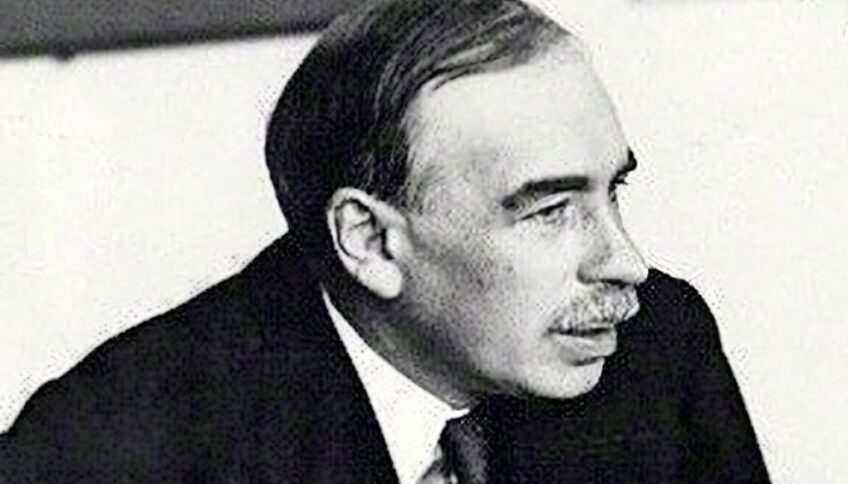
 John Maynard Keynes, the lord of the endless deficit and the architect of the coming default. If you took Econ 101 in college you surely have heard of him. I heard of him in high school econ. If you have heard or believed that debt limits for governments are meaningless, you at least have been exposes to his theories. The congressmen who vote for continued increases in the national debt ceiling are Keynsian.
Economists who get published and those who get Nobel Prizes are all Keynsians. We all know that the Nobel Prize is an expensive political tool of the humanists, correct? How else would it be possible for a sitting president with no peacemaking track record to be awarded the prize? It must have been for good intentions because it could not have been for actual peacemaking. Better yet, it was for agreeing with the Nobel committee’s political philosophy, what Thomas Sowell calls, “the vision of the anointed.”
I recently read an article by a non-economist spouting the virtues of Keynes and deficit spending. He said that any contrary theory to Keynes had been sounded disproven. Really? He didn’t offer any evidence. It would be better to ask what proof there is that Keynes was right. The long term consequences of his theories are yet to be seen and the chickens are coming home to roost.
Here is an excellent article by Gary North explaining why Keynes’ ideas dominate the entire world’s monetary system and why it will inevitably lead to failure, How the Keynesians Won…And Will Lose. Most of the links in the article are to excellent books and they are free. If you are at interested, and you should be, they are worthy reads.
One of those free books is Murray Rothbard’s The Mystery of Banking (1983) in which the author shows that the fractional reserve banking system is a system of wealth redistribution by fraud. He isn’t talking about socialists ideas about wealth distribution, rich to poor. Schemes of wealth redistribution always violate the Law of God, thou shalt not steal. Regardless of their intentions these programs always make the poor poorer and the rich richer. The prophets railed against the leadership of Israel and Judah for this very kind of civil government misbehavior and corruption. If you are not sure what the fractional reserve banking system is, read the book or look it up on Wikipedia.
North quotes Keynes at the end of the article from the conclusion to Keynes book The General Theory.
The ideas of economists and political philosophers, both when they are right and when they are wrong are more powerful than is commonly understood. Indeed, the world is ruled by little else. Practical men, who believe themselves to be quite exempt from any intellectual influences, are usually slaves of some defunct economist.
Benjamin Wiker begins the introduction to his wonderful book, 10 Books that Screwed up the World and Five More that Didn’t Help, by quoting Cicero, “There is nothing so absurd that it can’t be said by a philosopher.” Wiker continues, “These ideas float, largely undetected, in the intellectual air we breathe.”
No one questions these ideas, including most Christians. Thank God for folks like Gary North who actually believe that the Bible is for all of life, including the economy and the government. Is fooling around with the economy and the money supply a legitimate function of civil government?
I don’t remember where I read it but I recall a quote from Keynes from the days when he was foisting his ideas on the world. He said something like the last obstacle to implementing his ideas was that dratted puritan ethic that governed his native England. If that is true, and I think it is, I hereby offer two observations, even a third which is a conclusion from the first two plus a fourth, a corollary to the conclusion:
- The powerful impact on a culture of a small group of believers committed to the idea that the Bible is for all of life and that the Law of God is for us. According to my friend, Bojidar Marinov, the Puritans at their apogee never reached more than 3% to 5% of the population of England yet three and a half centuries later their ethic still influenced England to such a degree that Keynes considered it an obstacle to what he wanted to accomplish.
- Keynes knew that what he was proposing was immoral and against the Law of God.
- Conclusion: What Christian economists propose for the economies of the nations’ better start and finish with God’s Law. Whatever is outside God’s law will inevitably draw His judgment. As in the case of Solomon’s sin, it fell on the succeeding generations (1 Kings 11, 12).
- Christian economists had better study the Law of God or they will not be economists faithful to God. Well, that applies to all Christians as well, don’t you think?